



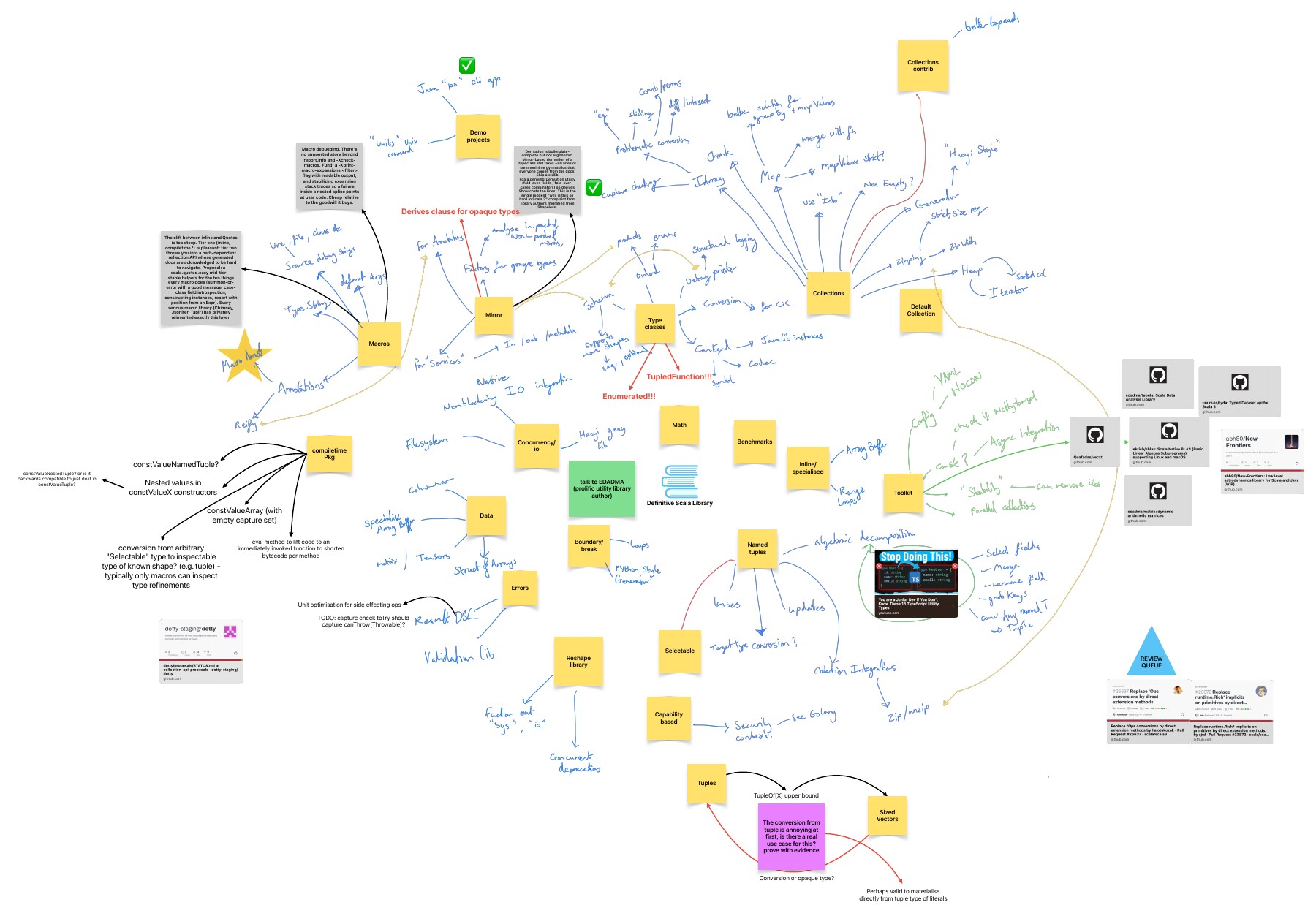
scala-reflect still haunts Scala 3 👻
 dotty-staging/dotty:scala-reflect-port
wick library wraps Spark with typesafe datasets.
Unfortunately broken on Scala 3.8+ due to the unified Scala library.
PROTOTYPE
scala-reflect ported to Scala 3
100% test coverage, drop-in, enables Wick to load.
should we release this? 🤠


Proposal: Reactor model · interleave compute and I/O
One thread per reactor · queue compute tasks, pending I/O, and timers
Event queue
Dispatch on the reactor thread
Task A · Task B
Task A calls perform(read) · A suspends
Task B
Run other work · A's read is still pending
I/O finishes → completion enters the event queue
Completion A
Handle the outcome · schedule A to resume
Task A · resumed
Process the result · continue after perform
Kqueue: readiness → perform I/O → completion
io_uring: submit I/O → completion · design target
Reactor + Gears: direct-style async
RPC: write request to server, wait for response
multiplatform API · (JVM, Native, Wasm)
ReactorFutures.run { r =>
  while buf.hasRemaining() do
    perform(r,
      r.ops.write(socket, buf))
  var running = true
  while running do
    buf.clear()
    perform(r, r.ops.read(socket, buf))
    running = buf.position() != 0
    if running then
      buf.flip()
      drainTo(buf, response)
}
run creates an event queue "reactor" r on the current thread, scheduling its argument.
Stage 1: loop to write to socket
perform registers the command to the reactor, and suspends the task. Reactor resumes it post-completion.
write creates a command, upon resume I/O was already performed.
Appears like blocking code: concurrency is abstracted.
Reactor + Gears: direct-style async
RPC: write request to server, wait for response
multiplatform API · (JVM, Native, Wasm)
ReactorFutures.run { r =>
  while buf.hasRemaining() do
    perform(r,
      r.ops.write(socket, buf))
  var running = true
  while running do
    buf.clear()
    perform(r, r.ops.read(socket, buf))
    running = buf.position() != 0
    if running then
      buf.flip()
      drainTo(buf, response)
}
Stage 2: loop to read from socket
Keep performing read until nothing is written to buf.
drain after each read to the response.
Appears like blocking code: concurrency is abstracted.
Structured concurrency in Gears: static safety
def onWorkerPool(
  body: () ->{any.except[ThreadLocal]} Unit
): Unit =
  workerPool.execute(() => body())

ReactorFutures.run { r => // reactor thread
  onWorkerPool(() =>
    perform(r, r.ops.read(socket, buf))
  )
  Async.group:
    val pending = Future:
      perform(r, r.ops.read(socket, buf))
    buf.clear() // rejected: until group ends
    pending.await
  buf.clear() // allowed: group ended
}
onWorkerPool runs callback on a separate thread pool, rejecting thread-local state.
Error: body captures ThreadLocal reactor r.
(onWorkerPool is not the reactor thread.)
Error: buf is unavailable to the parent until the group ends, even after pending.await.
Group exit restores the parent's access to buf.
Future Vision for language safety: statically enforce where tasks run and what resources they may retain.

Proposal: Result for error handling in direct style
Incubator for the Result[T, E] type.
Result · success or a typed error
enum Result[+T, +E]:
  case Ok[+T](value: T)
    extends Result[T, Nothing]
  case Err[+E](error: E)
    extends Result[Nothing, E]
compose dependent values
def parseInt(s: String): Result[Int, Err] = …
val (a, b) = ("123", "456")
Result:
  parseInt(a).ok + parseInt(b).ok
.ok unwraps or breaks out of Result: with Err.
SIP-84 Under review evolves this to an unboxed representation
Result[T, E] is now T ? E
Result: is now maybe:
r.ok is now r?
Proposal: Validation in direct style
Create an account
Stage 1 · all fields present, now parse and check
Name
Ada
✓ Name is present
Age
sixteen
✕ Enter a whole number
ada@
✕ Enter a valid email
Stage 2 · checks that need a valid field
↓ No parsed age
18 or older?
Skipped until parsing succeeds
Collect errors across fields. Stop only the checks that depend on a failed value.
Validation Stage 0: test non-empty
Account form · all required fields must be present
import steps.result.Validation
import Validation.{scope, Validated}

case class Form(
  name: String, age: String, email: String)

def checkFields(f: Form): Validated[Unit, String] =
  Validation.validated:
    scope.test(f.name.nonEmpty, "Name: required")
    scope.test(f.age.nonEmpty, "Age: required")
    scope.test(f.email.nonEmpty, "Email: required")
Validated[A, E] =:=
Result[A, List[E]]
Open a validation scope.
scope value accumulates errors.
Simple Boolean Tests
no early abort, failures are accumulated.
checkFields(Form("", "", "")) → three required-field errors, together.
Validation Stages 1 & 2: parse and then transform
case class Account(name: String, age: Int, email: Email)
def validateForm(f: Form): Validated[Account, String] =
  Validation.validated:
    // stage 0
    scope.testAll(checkFields(f)).ok
    // stage 1
    val n = scope.test(parseName(f.name))
    val a = scope.test(parseInt(f.age))
    val e = scope.test(parseEmail(f.email))
    // stage 2
    val age = a.ok
    scope.require(age >= 18, "Age: must be 18+")
    Account(n.ok, age, e.ok)
"sixteen" → parse error · "16" → age rule error · "21" → success
Stage 0: merge errors: add to scope
Stage 0: .ok breaks early on stage 0 error.
State 1: Parse values with Result
each test may record an error in the scope, returning a handle on the value.
Stage 2: extract age
.ok breaks early if a had an error.
Stage 2: Validate age
Stage 2: break early with require
Stage 2: Extract remaining Result
don't force before checking age.
Proposal: Validation scope prevents shared mutation.
Batch signup · flag a duplicate email on both forms
def checkEmailConflict(a: Form, b: Form)(
    aErrors: Validation[String]^,
    bErrors: Validation[String]^
): Unit =
  val dupMsg = "Email: duplicated in batch"
  val distinct = a.email != b.email
  aErrors.test(distinct, dupMsg)
  bErrors.test(distinct, dupMsg)
Rejected · pass the same collector twice
Validation.validated[Unit, String] {
  checkEmailConflict(a, b)(scope, scope)
}
Validation is stateful and exclusive
class Validation[E]
  extends Stateful,
    ExclusiveCapability:
  // implementation omitted
^ grants exclusive write capability.
One writer for each form's error list.
Error: Separation Failure
Arguments aErrors and bErrors both capture scope.
A duplicate email gives each form its own error. Two write parameters cannot alias.

Flagged: migration from @main
Before
@main def serve(
  host: String, port: Int = 8080, files: String*
): Unit = ...
After
@cmd def serve(
  host: String, port: Int = 8080, files: String*
): Unit = ...

@main def run(args: String*): Unit =
  Flagged.parseOrExit[this.type](args)
./serve.scala localhost 7777 foo.scala
unchanged except for @main → @cmd.
foo.type => search for @cmd methods.
default behavior same as @main:
positional parameters
Flagged: type class derivation also
Before
@cmd def serve(
  host: String, port: Int = 8080, files: String*
): Unit = ...
After
case class Serve(
  host: String, port: Int = 8080, files: String*
) derives Parser.Command

@main def run(args: String*): Unit =
  val serve = Flagged.parseOrExit[Serve](args)
  ...
./serve.scala localhost 7777 foo.scala
typical type-class derivation flow.
class type => look for Parser[T].
still same default behavior
Flagged: evolve to named arguments
Previously · positional arguments
./serve.scala localhost 7777 foo.scala
Add annotations to the same method
case class Serve(
  @opt host: String,
  @opt(short = 'p') port: Int = 8080,
  files: String*
) derives Parser.Command
Now · named options, with the same values
./serve.scala -p 7777 --host localhost foo.scala
./serve.scala --host localhost foo.scala
@opt makes a parameter named.
port accepts --port or -p.
Omit --port to use default arg.
Unannotated files stays positional.
Named parameters in any order!
Flagged: Nested subcommands
Git-style CLI · two levels of subcommands
enum Gitto derives Parser.CommandGroup:
  case Clone(repo: String,
    @opt(short = 'd') depth: Option[Int] = None)
  case Remote(action: RemoteAction)
  case Status(@opt(short = 's') short: Boolean = false)

enum RemoteAction derives Parser.CommandGroup:
  case Add(name: String, url: String)
  case Remove(name: String)

@main def gitto(args: String*): Unit =
  val cfg = Flagged.parseOrExit[Gitto](args)
  ...
./gitto.scala remote add origin \
  https://github.com/lampepfl/gears.git
uses type-class derivation
Level 1: remote selects a nested command group.
Level 2: add selects a command within that group; name and url are positional arguments.
One parse returns a nested value:
Gitto.Remote(
RemoteAction.Add(...))
Proposal: Mirrors for derivation · annotations, default-args, methods
Annotations · option names, flags, help
trait AnnotMirror[T]:
  type MirroredSelfAnnotations <: Tuple
  type MirroredAnnotations <: Tuple
Defaults · values for omitted arguments
trait Defaults[A]:
  def hasDefault(index: Int): Boolean
  def defaultArgument(index: Int): Any
Methods · parameter structure and invocation
trait MethodMirror[T]
    extends Defaults[Any]:
  type MirroredElemLabels <: Tuple
  type MirroredElemTypes <: Tuple
  type MirroredResult

  def invoke(args: Array[Any]): Any
Metadata in types · defaults and calls in methods
Proposal: compiler generated Mirrors
Flagged · generation entry points
transparent inline given ofProduct[T]:
    AnnotMirror.Product[T] =
  ${ macros.AnnotationMacros.annotMirrorProduct[T] }

inline def derived[A]: Defaults[A] =
  ${ macros.DefaultMacros.defaults[A] }

transparent inline given of[T]: MethodsMirror.Of[T] =
  ${ macros.MethodMacros.methodsMirror[T] }
Today: macros discover the source metadata and generate witnesses.
Proposal: the compiler synthesizes these witnesses, as it does for scala.deriving.Mirror.
Library authors consume a shared interface through ordinary inline derivation.
An annotation Mirror for supplied arguments
Annotation occurrence
case class Greet(
  @opt(short='w') who: String)
case class opt(
  name: String = "",
  help: String = "",
  short: Char = '\u0000',
  // ... more parameters
) extends StaticAnnotation derives Defaults
Annotation Mirror reflects explicit literal arguments:
ArgumentList[opt,
  "short" *: EmptyTuple, 'w' *: EmptyTuple,
  2 *: EmptyTuple]
Only short is supplied.
how do we materialise the other params?
name and help use their default.
short is the third parameter (index 2).
Defaults mirror provides arguments.
Capture the supplied argument label and literal value.
short is the third parameter (index 2).
Defaults mirror provides the rest.
Idiomatic inline derivation @opt(short='w')
Annots.fieldAnnotsOfSome · non-empty arguments, abridged
inline erasedValue[m.MirroredAnnotations] match
  case _: (ArgumentList[opt,
      ns, vs, ?] *: ?) =>
    collectField[ns, vs](
      name = "", short = MaybeChar.empty, help = "",
      positional = false, …)
Annots.collectField · selected cases
inline erasedValue[(Ns, Vs)] match
  case _: ("short" *: nt, v *: vt) =>
    collectField[nt, vt](
      name, MaybeChar(constValue[v & Char]),
      help, positional, hidden,
      group, aliases, split, greedy)
  case _: (EmptyTuple, ?) =>
    FieldAnnots(name, short, help, positional,
      hidden, group, aliases, split, greedy)
Find @opt in this field's annotations.
Only need the explicit named arguments
traverse the explicit arguments.
shortcut: prefill default arguments
consume short = 'w' argument from head
recursive call on tail types
materialize 'w' from its singleton type.
After explicit arguments are consumed, build one record. Defaults provided in initial call.
Derivation: fast to compile, too
Compile one generated CLI source · milliseconds · warm compiler · lower is better
| CLI shape | No parser | Flagged | mainargs | case-app |
|---|---|---|---|---|
| 10 mixed fields | 53.6 ± 4.8 | 100.9 ± 8.6 | 241.1 ± 25.1 | 460.7 ± 34.4 |
| 25 defaulted fields | 47.3 ± 2.4 | 123.2 ± 16.3 | 246.3 ± 19.0 | 502.5 ± 42.5 |
| 3 subcommands | 48.6 ± 4.5 | 108.6 ± 7.1 | 264.9 ± 21.5 | 467.2 ± 65.3 |
| 3 command methods | 29.6 ± 1.4 | 113.6 ± 9.7 | 254.5 ± 43.4 | 497.3 ± 144.2 |
| Docker-style CLI | 58.1 ± 5.8 | 164.3 ± 10.5 | 213.0 ± 25.7 | 520.5 ± 68.6 |
47–106 ms added over the no-parser baseline · lowest compile time of the three libraries in every scenario.
Flagged: Lowest Latency and Allocations
Flagged · construct a parser for a Docker-CLI clone and parse the args.
| Parser | Time (µs/op) | Allocation (B/op) |
|---|---|---|
| Flagged | 2.247 ± 0.016 | 13,720 |
| mainargs | 11.482 ± 0.203 | 41,614 |
| scopt | 49.027 ± 0.624 | 107,901 |
| case-app | 51.935 ± 2.442 | 369,246 |
| scallop | 141.698 ± 0.598 | 445,675 |
| picocli | 232.840 ± 2.293 | 396,725 |
5.1× faster than the next parser in this workload.

Tuple element types with a common upper-bound
bishabosha / NamedTupleUtil.scala
Check the numeric age, then render the whole row
val row = (Text("Jamie"), Number(42))
require(row(1).value >= 18) // precise per-elem type

render(row)
// Jamie,42
trait Cell { def text: String }

def render[T <: Tuple: ElemsOf[Cell]](cells: T) =
  elemsIterator[T, Cell](cells)
    .map(_.text).mkString(",")
type ElemsOf[I] =
  [T <: Tuple] =>> Tuple.Union[T] <:< I
Keep the type at each position.
row(1) is a Number; its .value is an Int. A Seq[Cell] loses that precise type.
Iterate without casts in the renderer.
With this evidence, elemsIterator returns an Iterator[Cell], so each element has .text.
A heterogeneous tuple.
Text | Number is the union of its element types. Both must be below Cell.
Named Tuples with common field labels
bishabosha / NamedTupleUtil.scala
Cells in the row; strings in its matching headings
type PersonRow = (name: Text, age: Number)

val row =
  (name = Text("Jamie"), age = Number(42))
val titles =
  (name = "Full name", age = "Age (years)")

report[PersonRow](row)(titles)
Full name: Jamie
Age (years): 42
Merge two separate sources with different field types, but matching labels and order.
Named Tuples with common field labels
bishabosha / NamedTupleUtil.scala
The report takes cells and a matching record of headings
def report[
  Row <: AnyNamedTuple: FieldsOf[Cell]
](row: Row)[
  Titles <: SameFields[Row]
            : FieldsOf[String]
](titles: Titles): String =
  fieldsIterator[Titles, String](titles)
    .zip(fieldsIterator[Row, Cell](row)) …
type FieldsOf[I] = [F <: AnyNamedTuple] =>>
  ElemsOf[I][NamedTuple.DropNames[F]]

type SameFields[F <: AnyNamedTuple] =
  NamedTuple.Map[F, [_] =>> Any]
Prove the input bound.
DropNames exposes the value tuple, so every field must implement Cell.
Preserve labels and order. Forget the original value types; keep the record's fields.
Transform cells into heading strings.
Independently prove that every supplied heading is a String.
Callback: structural types
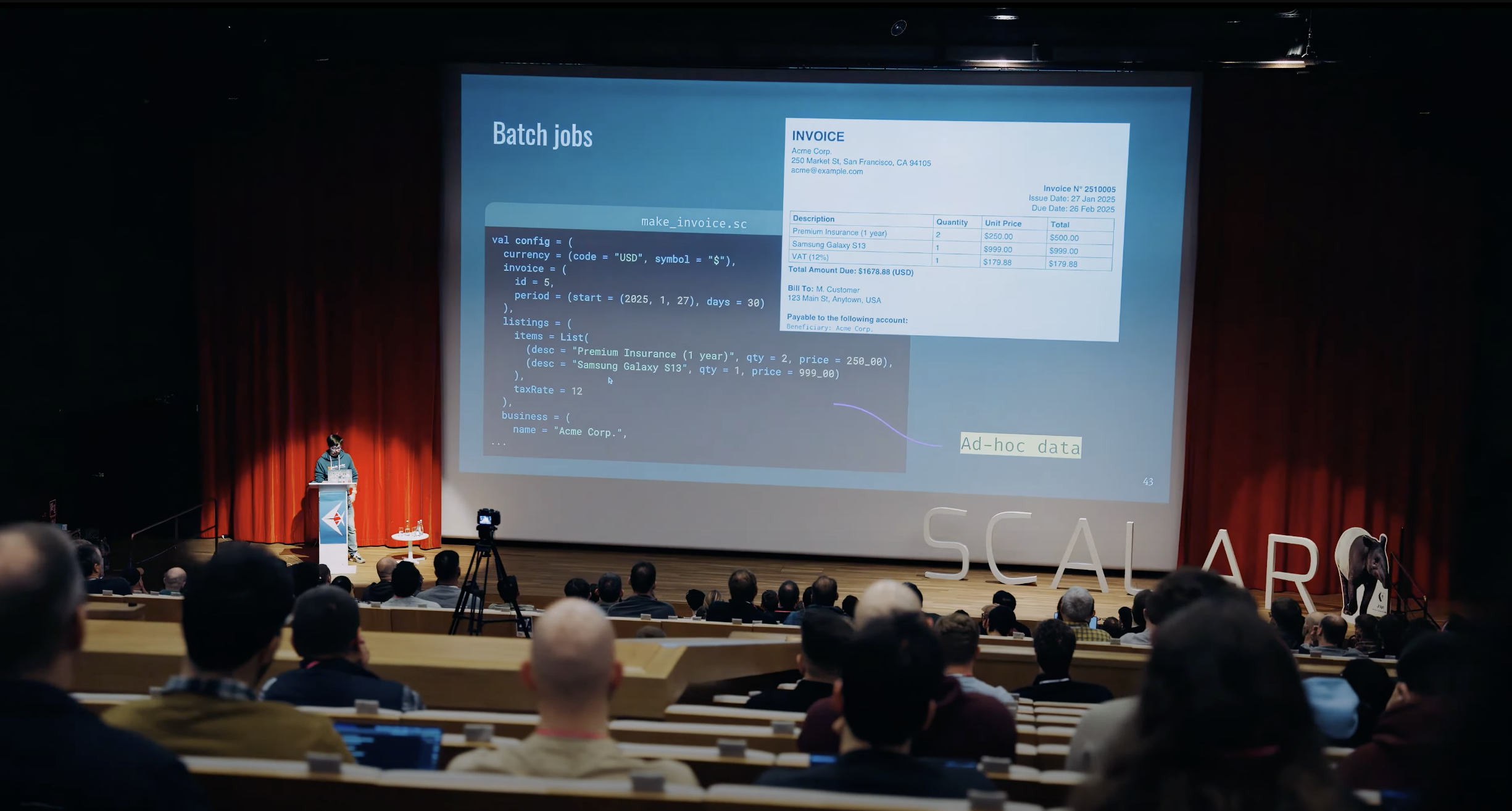
Named tuples for "Bulk data" · Expand image
 Jamie Thompson: Going Structural with Named Tuples [Scalar 2025]
Callback: structural types
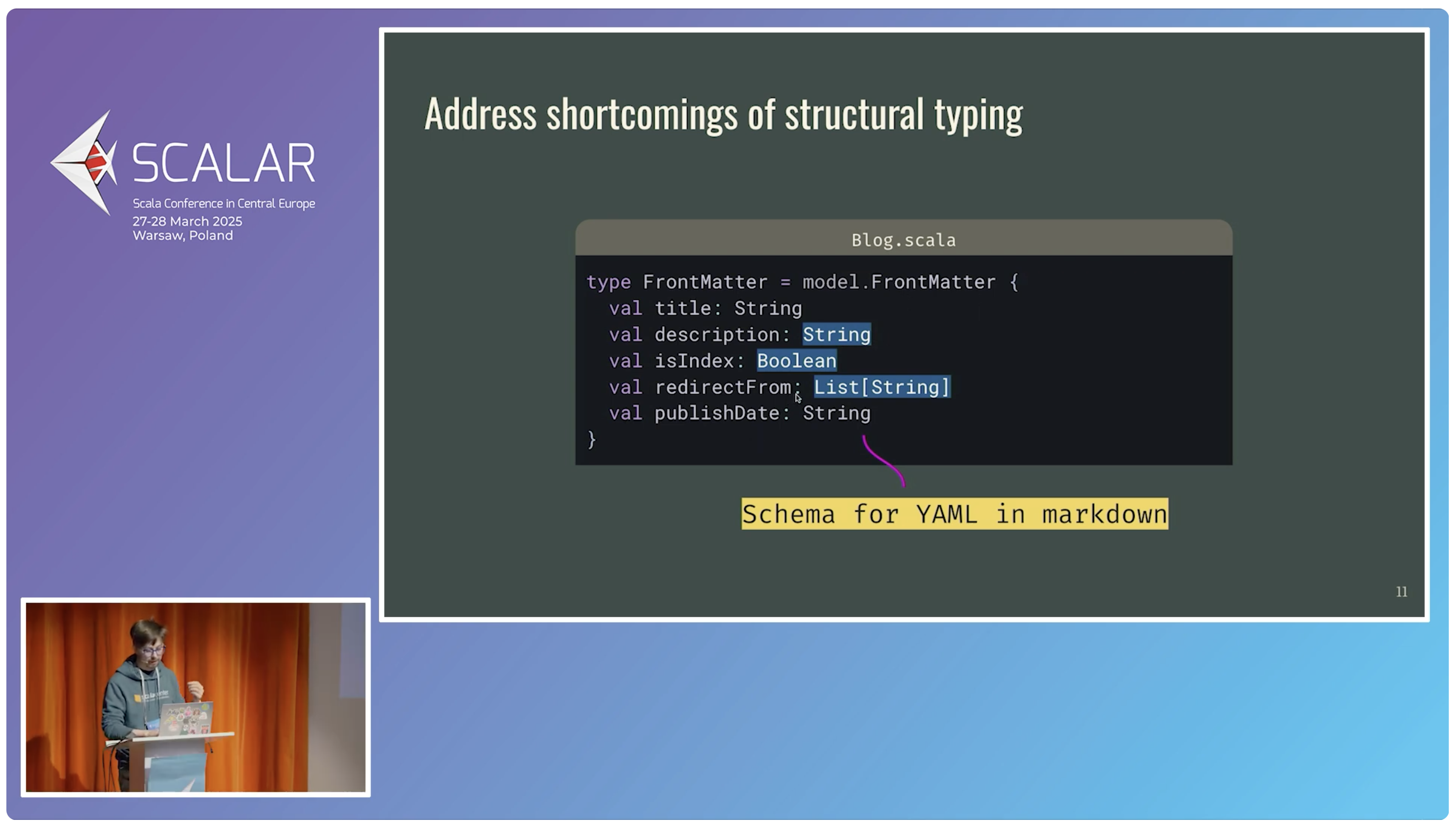
Refinements for extensible structural types · Expand image
Named tuples for nested data
Why can't NamedTuples be as useful as TypeScript's records?
// Invoice.scala
val config = (
  invoice = (
    id = 5,
    period = (start = "2025/1/27", days = 30)
  ),
  listings = (
    items = Vector(
      (desc = "Premium Insurance (1 year)",
        qty = 2, price = 250),
      (desc = "Samsung Galaxy S13",
        qty = 1, price = 999)
    ),
    taxRate = 12
…
Parsing values from text
How do we extract a date and calculate when payment is due?
Deep nesting
I want to talk about the items, without explicitly redeclaring their type.
Selecting types inside a nested record
Declare a single structure for the deeply nested data
type Invoice = (
  invoice: (
    id: Int,
    period: (start: String, days: Int)
  ),
  listings: (
    items: Vector[
      (desc: String, qty: Double, price: Int)
    ],
    taxRate: Int,
  )
…
1 · Select the record
type Listings =
  SelectField[Invoice, "listings"]
2 · Select its collection
type Items =
  SelectField[Listings, "items"]
3 · Select the element type
type Item = SelectElem[Items]
type Item stays in sync with type Invoice
Invoice→Listings→Items→Item
InvoiceSelectField[Invoice, "listings"]SelectField[Listings, "items"]SelectElem[Items]
Proposal: match types for NamedTuple path traversal
match-types → algebraic operations for nested data
type SelectField[NT <: AnyNamedTuple, K <: String] =
  NT match
    case NamedTuple[ns, vs] => Search[K, ns, vs]

type SelectElem[S <: Seq[?]] = S match
  case Seq[e] => e

type Search[K <: String, Ns <: Tuple, Vs <: Tuple] =
  (Ns, Vs) match
    case (K *: _, v *: _)   => v
    case (_ *: ns, _ *: vs) => Search[K, ns, vs]
Find the field
Walk names and value types together.
Then unwrap its container
The output of one operation feeds the next.
 Jamie Thompson: Effective Match Types [Scala Days 2025]
Parsing useful data
bishabosha / 1 - On Configuration and Named Tuples.md
// Invoice.scala
val config = (
  invoice = (
    id = 5,
    period = (start = "2025/1/27", days = 30)
…
Prototype apply functions directly within deeply nested data
val parser = ParseFrom.identity[Invoice]
  .patch(
    Patch(_.invoice.period.start)
      .to[LocalDate]
  )
val application = parser.tryRead(config)
Data provides only text
The invoice needs a date to calculate when payment is due.
Select where change occurs
apply a function at this path.
String → LocalDate
Parse yyyy/M/d; report an invalid date.
Parsing useful data
bishabosha / 1 - On Configuration and Named Tuples.md
Prototype apply functions directly within deeply nested data
val parser = ParseFrom.identity[Invoice]
  .patch(
    Patch(_.invoice.period.start)
      .to[LocalDate]
  )
given ParseFrom[String, LocalDate]:
  def tryRead(in: String)
    : Validated[LocalDate, Err] =
  Validation.validate(…)
Select this nested leaf
Keep days and the rest of the invoice.
String → LocalDate
Parse yyyy/M/d; report an invalid date.
Propagate errors
each patch can have independent errors.
Scala Object Notation: Declare the structure you need
bishabosha/scala-object-notation
type Invoice = (
  invoice: (
    id: PosInt,
    period: (start: LocalDate, days: PosInt)
  ),
  listings: (
    items: Vector[
      (desc: String, qty: BigDecimal, price: Int)
    ],
    taxRate: Range[0, 100],
  )
…
given ReadWriter[PosInt] = …
given ReadWriter[LocalDate] = …
given [A, B] => ReadWriter[Range[A, B]] = …
val text = os.read(
  os.pwd/"Invoice.scala"
) // = "val config = (…)"

given ReadWriter[Invoice] = …

scalanotation.Readers
  .readDeclsAs[Invoice](text)
Semantic types: No more Int, String.
Validate and transform
Int → PosInt or Range[0, 100];
String → LocalDate
Parse basic values into semantic data, or reject with a error message.
Scala Object Notation: mapped schemas
bishabosha/scala-object-notation
def parseDate(s: String):
  Result[LocalDate, DecodeError] = …

given ReadWriter[LocalDate] =
  summon[ReadWriter[String]]
    .bimapResult(parseDate)(_.toString)
Reified Function
How to tear-down/construct type A from an abstract structure.
Mapped Schema
A LocalDate is structurally "a String", but adds validation
Scala Object Notation: a bad date
bishabosha/scala-object-notation
Invoice.scala · excerpt
val config = (
  invoice = (
    id = 5,
    period = (start = "2025-1-27",
      days = 30)
  ),
  // listings unchanged
)
Read using the mapped LocalDate schema
Readers.readDeclAs[Invoice](
  text, rootName = "config"
)
4:15: In path '.invoice.period.start':
Text '2025-1-27' could not be parsed
at index 4
The full decoding error: source line and column, nested field path, and the date parser's explanation.
The mapped schema expects yyyy/M/d.
Write "2025/1/27" instead.
Scala Object Notation: a missing codec
bishabosha/scala-object-notation
A custom type deep inside the invoice schema
final class Money(val cents: Int)

type Invoice = (
  listings: (
    items: Vector[(desc: String,
      qty: BigDecimal, price: Money)],
    taxRate: Int
  )
)

given ReadWriter[Invoice] =
  ReadWriter.ofFields[Invoice]
at path '.listings.items[].price':
Could not find ReadWriter[Money].
Derivation points to the missing leaf.[] means an element of the collection.
Supply the leaf codec, then derive again
given ReadWriter[Money] =
  summon[ReadWriter[Int]]
    .bimap(new Money(_))(_.cents)
RawSchema: structure + operations
bishabosha/scala-object-notation
Interpreters use the structure and these operations to work with your values.
Scala Object Notation: schemas compose
bishabosha/scala-object-notation
ReadWriter[InvoiceSchema]
invoice · named tuple
idPosInt mapped from Int
period · named tuple
startLocalDate mapped from String
daysPosInt mapped from Int
listings · named tuple
items · Vector
Element schema · named tuple
descString
qtyBigDecimal
priceInt
taxRateRange[0, 100] mapped from Int
contextual derivation composes leaf schemas automatically.
One declaration, many interpreters
bishabosha/scala-object-notation
Declare once
ReadWriter[InvoiceSchema]
RawSchema: structure + cursors + builders
…or another interpreter of the same schema.
Declare your data once. Each interpreter decides what to do with it.
Universal Schema: router
bishabosha/scala-object-notation
data with no known schema, e.g. raw JSON, YAML, etc.
RawSchema.Router[A] · self
Children reuse the same schema
interopable with upickle, scala-yaml, etc.
Proposal: Install default values within Structural types.
bishabosha/scala-object-notation
Sample config data structure, we want to supply defaults dynamically.
type Config = (
  db: Option[(
    host: String,
    port: Int,
    replicas: Vector[(host: String, port: Int)]
  )]
)
given DefaultValues[Config] = DefaultValues.of { c =>
  Seq(
    c.db := Some(("120.0.0.1", 5432, Vector())),
    c.db.some.port := 5432,
    c.db.some.replicas.each.port := 5432
  )
}
Step into optional/sequence types.
e.g. they provided a host but no port.
Proposal: Selectable paths that work with Option/Vector.
bishabosha/scala-object-notation
class Path[T, AtField <: Boolean] extends Selectable:
  type Fields = NamedTuple.Map[
    NamedTuple.From[T],
    [F] =>> Path[F, true]
  ]
  def selectDynamic(name: String): Path[?, true] = ...
extension [T](path: Path[T, ?])
  def some(using r: OptionLike[T]): Path[r.Inner, false] = ...
  def each(using r: VectorLike[T]): Path[r.Inner, false] = ...

extension [T](path: Path[T, true])
  def :=(value: T): Binding = ...
1 · Project fields into Path
select a field of T to extend the Path.
DefaultValues.of: c =>
  c.db // c.selectDynamic("db")
2 · Unwrap a container
DefaultValues.of: c =>
  c.db.some.replicas.each
3 · Install a binding only at a field
DefaultValues.of: c =>
  c.db.some.port := 5432
No need for complex match-types to handle field selection.
SCON decoding: allocation and throughput
bishabosha/scala-object-notation
Decode 100 order records from strings. SCON uses SCON text; the others use JSON.
| Decoder | Time (µs/op) | Allocation (B/op) |
|---|---|---|
| jsoniter-scala | 9.594 ± 0.136 | 16,344 |
| zio-blocks | 12.647 ± 0.062 | 16,360 |
| SCON, batched + typed | 17.294 ± 0.062 | 9,696 |
| uPickle | 46.452 ± 0.903 | 113,904 |
Less allocation here; still slower than jsoniter-scala and zio-blocks.
Proposal: Result.task for typed side-effects
SCON as a Result.task testbed.
def decodeField(): Result[Unit, DecodeError] =
  Result.task:
    decodeInt().check
    slots.setInt(0, pullIntValue())
object Result:
  …
  val done: Result[Unit, Nothing] = Ok(())
Unit returning block
decodeInt() pushes int to slot.
.check breaks to task: on failure.
Update the builder as a side effect.
successful task: block returns done
On happy path: no allocations for successful blocks.

Record-prefix conformance
class Record[T <: AnyNamedTuple](private val live: T)
    extends Selectable:
  type Fields = T
  inline def selectDynamic(name: String): Any =
    live.productElement(constValue[IndexOf[Name, Fields]])
type Parent = (id: String)
def idOf(meta: Record[Parent]): String = meta.id
val parent = Record((id = "record-slide"))
val slide = parent ++ (layout = "standard")

idOf(parentView(slide)) // "record-slide"
slide.layout            // "standard"
def parentView[T <: AnyNamedTuple](r: Record[T])(
  using Record.IsSubPrefix[T, Parent]
): Record[Parent] = r.asInstanceOf[Record[Parent]]
Named tuple fields, record interface.
Fields = T gives typed selections such as meta.id.
Access fields by index (shared prefix fields have same offsets)
slide appends (layout: String).
Its prefix is still the fields of parent.
Downcast slide to Parent safely
Proof Parent's fields are the prefix of T's
Use case: extensible markdown slide generator.
TemplateFunctions.scala
class TemplateFunctions[T <: AnyNamedTuple](
  private val functions: Record[T]
) extends Selectable:
  type Fields = T
TalkRevealTheme.apply · layout and page settings abbreviated
object TalkRevealTheme:
  def apply(fonts: DeckFonts = DeckFonts()) =
    RevealTheme.withTemplates(
      RevealTheme.defaultTemplates ++
        WhiteboardTemplates.templates,
      …
    )
Templates are a record of functions.
TemplateFunctions[T] wraps Record[T] and exposes its named fields through Selectable.
Extend the record; pass it to the parent. Customise markdown with extra functions.
The parent requires its original fields as a prefix.
Powering Presentation Generation
RevealTheme · structural types to the max
case class SlideMeta(
  id: String, seconds: Int = 5, layout: String
)

class RevealTheme(...) extends Theme:
  ...
  type SiteMap = (
    deck: Directory[(
      index: Doc[DeckMeta],
      `speaker-notes`: Doc[NotesMeta],
      slides: Docs[SlideMeta]
    )]
  )
- SiteMap: nested structural type.
- 1:1 with directory layout
- centralised access to metadata across-pages.
Each document exports Typed frontmatter
Kqueue: poll, then perform I/O
RPC: write request to server, wait for response
Scala Native · macOS, FreeBSD targets only
registerWrite(kq, socket)
var running = true
while running do
  val n = pollEventsForever(kq, events, capacity)
  for i <- 0 until n if running do
    val event = events(i)
    if isWriteEvent(event) then
      nioWriteBytes(socket, buf)
      if !buf.hasRemaining() then switchToRead(kq, socket)
    else if isReadEvent(event) then
      buf.clear()
      val bytesRead = nioReadBytes(socket, buf)
      running = bytesRead != EOF
      if bytesRead > 0 then
        buf.flip()
        drainTo(buf, response)
register WRITE interest
Loop forever
BLOCK in kevent until sockets are ready. Return a batch of events.
Loop through the batch of events.
check for WRITE events
do WRITE I/O
drop WRITE, register READ interest
check for READ events
do READ I/O
drain each chunk to the response.
What happens to this input?
bishabosha/scala-object-notation
SCON text
(db = (port = 5432, host = "db"),
 weights = Vector(2, 1))
Application types
case class Endpoint(port: Int, host: String)
case class Config(
  db: Option[Endpoint], weights: Array[Int]
)
Primitive and reference fields
inside a nested record.
The schema chooses the result:
an optional object and an integer array.
The cursor reads a typed value
bishabosha/scala-object-notation
(db = (port = 5432, host = "db"), weights = Vector(2, 1))prims[0]—refs[0]—Borrow BuilderSlots for Endpoint. The cursor reaches the next Int.
5432prims[0]—refs[0]—Read the raw number into the Int cell.
5432prims[0]5432refs[0]—Copy the raw Int into BuilderSlots at prims[0], without boxing.
The cursor moves to the String
bishabosha/scala-object-notation
(db = (port = 5432, host = "db"), weights = Vector(2, 1))5432prims[0]5432refs[0]—The cursor advances to the String.
5432@hostprims[0]5432refs[0]—@host"db"Copy a reference '@host' into the Ref cell, a reference to the parsed string object.
5432@hostprims[0]5432refs[0]@host@host"db"Copy @host into the borrowed BuilderSlots at refs[0]. Both slots refer to the same String.
The constructor pulls from BuilderSlots
bishabosha/scala-object-notation
(db = (port = 5432, host = "db"), weights = Vector(2, 1))5432@hostprims[0]5432refs[0]@hostEndpoint(port = slots.getInt(0), host = slots.getRef(1))The record is complete. Its borrowed BuilderSlots holds both fields.
5432@hostprims[0]5432refs[0]@hostEndpoint(port = 5432, host = slots.getRef(1))getInt(0) pulls port directly into the constructor argument, without boxing.
5432@hostprims[0]5432refs[0]@hostEndpoint(port = 5432, host = @host)getRef(1) pulls the same String reference for host.
5432@hostprims[0]5432refs[0]@host@endpointEndpoint(port = 5432, host = @host)The factory invokes Endpoint with those two arguments.
5432@endpointprims[0]5432refs[0]@host@endpointEndpoint(port = 5432, host = @host)pushRef publishes the new Endpoint reference in the decoder’s Ref slot.
5432@endpointprims[0]5432refs[0]@host@endpointEndpoint(port = 5432, host = @host)Release BuilderSlots to the pool. Endpoint keeps its values, not the buffer.
The child becomes a parent field
bishabosha/scala-object-notation
(db = (port = 5432, host = "db"), weights = Vector(2, 1))5432@endpointrefs[0]—refs[1]—@endpointEndpoint(port = 5432, host = @host)Config.db field expects Option[Endpoint]. So we need to wrap @endpoint.
5432@databaserefs[0]—refs[1]—@databaseSome(@endpoint)@database wraps the existing @endpoint reference in Some(...), stored in the Ref cell.
5432@databaserefs[0]@databaserefs[1]—@databaseSome(@endpoint)Push the @database reference to the BuilderSlots for Config at refs[0].
The same slot feeds a typed array
bishabosha/scala-object-notation
(db = (port = 5432, host = "db"), weights = Vector(2, 1))2@databaseMoving on to weights... Read the first raw element into the same Int cell.
2@database2Append the Int cell's value to the typed array builder.
1@database2The cursor advances. Overwrite the Int cell with 1.
1@database21Append Int cell again. Both array elements are raw Int values.
1@weights21@weights@weightsArray[Int](2, 1)Finish the array. The Ref cell now points to the array object.
Config pulls from its own BuilderSlots
bishabosha/scala-object-notation
(db = (port = 5432, host = "db"), weights = Vector(2, 1))1@weightsrefs[0]@databaserefs[1]—@weightsArray[Int](2, 1)The completed array is ready for the Config builder.
1@weightsrefs[0]@databaserefs[1]@weights@weightsArray[Int](2, 1)Copy @weights into the Config's borrowed BuilderSlots at refs[1].
1@weightsrefs[0]@databaserefs[1]@weightsConfig(db = slots.getRef(0), weights = slots.getRef(1))The Config factory is ready to pull both arguments from BuilderSlots.
1@weightsrefs[0]@databaserefs[1]@weightsConfig(db = @database, weights = slots.getRef(1))getRef(0) pulls the completed Option reference for db.
1@weightsrefs[0]@databaserefs[1]@weightsConfig(db = @database, weights = @weights)getRef(1) pulls the completed array reference for weights.
1@weightsrefs[0]@databaserefs[1]@weights@configConfig(db = @database, weights = @weights)Construct Config from those references; no child objects are copied.
1@configrefs[0]@databaserefs[1]@weights@configConfig(db = @database, weights = @weights)pushRef places the completed Config reference in the decoder’s Ref slot.
1@configrefs[0]@databaserefs[1]@weights@configConfig(db = @database, weights = @weights)Return the parent’s BuilderSlots to the pool. Config is independent of it.
The completed Config becomes a Result
bishabosha/scala-object-notation
(db = (port = 5432, host = "db"), weights = Vector(2, 1))1@configResult[Config, DecodeError]Result.Ok(@config)@configConfig(db = @database, weights = @weights)One Ok wrapper at the public boundary, containing the existing @config.